Expanish Blog

Spanish School and Study Abroad Programs in Buenos Aires - Argentina

Expanish Blog header image 1

How to Get ‘Plugged In’ in Buenos Aires

July 2nd, 2009 · No Comments

There is no standard voltage or frequency (number of times the current changes direction per second) throughout the world and therefore every country requires that you bring the write plug-in or currency conversion equipment in order to avoid any sort of small, or big, firework display.  If you have plans to study Spanish in Buenos Aires and are wondering what kind of equipment you will be needing, here is a guide to electricity in Argentina!

Argentina has a single-phase voltage of 220V. That means, all you foreigners from the United States, Canada, Australia and many countries in Europe, you can not just plug in your equipment here, unless it has its own adapter (some laptops, ipod’s, etc.).  You must buy an adapter that will change the voltage to correspond with the voltage in Argentina.

Argentina has two different ‘socket’ types.  A socket is the part that gets plugged into the socket in the wall.
1) The first socket is often referred to as the ‘Euro plug’.  Here is an example of what it looks like:

2) The second socket has a ground pin and two diagonal prongs that make a V shape.
Here is what it looks like:

*3) This is sort of a rip-off of #2 but you can find the same above, without the bottom ground pin.

Remember, the photos above are of adapters however, these do not change the voltage! You will need an adapter that changes the actual voltage of your equipment from abroad.

If you have any comments or tips about electricity in Argentina, let us know!

→ No CommentsTags: argentina · buenos aires

Star Wars Exhibition in Buenos Aires this July & August!

July 1st, 2009 · No Comments


Buenos Aires is a city that constantly features new events, activities, exhibitions, premiers, and more, and once again this July there is an exciting exhibition that will bring you back to the 80’s and into your ‘Jedi’ days.  This July begins Star Wars The Exhibition at the Centro Cultural Recoleta, an event to great to be missed.

Traveling through the major cities of Latin America, in Buenos Aires Star Wars The Exhibition will be featuring more than 200 original props, costumes, life size models, movie artefacts, drawings, vehicles, and character models from the first three Star Wars movies, displayed in a Star Wars themed atmosphere. Character models such as Chewbacca, C3P0, R2D2, Jaba the Hut, Yoda, and many more of the alien creatures will be featured, as well as the costumes from Princess Leia, Luke Skywalker, Han Solo, Lando Calrissian, Obi-Wan, featured in glass enclosures.

The original life size props from the movies will also be displayed such as the ‘Imperial Speeder Bike’, ‘Jedi Starfighter’, ‘Anakin’s Airspeeder’, and more. The exhibit will also have 9 rooms dedicated to the different ‘worlds’ that the Star Wars movies were set, along with interactive activities for both children and adults.

Star Wars The Exhibit will take place at the Centro Cultural Recoleta, from July 2nd until the 30th of August, Tuesday to Friday (9-21pm), Saturday and Sunday (10-22pm).  Admissions is 35pesos, free for children under 3 years of age. Tickets can be bought at the doors of the centre or directly at TICKETTEK.

If you were any sort of Star Wars fan back in the day, or still are, this is both a bizarre and unique exhibit to see and a must-see event in Buenos Aires. So put on your Jedi face and head down to the Centro Cultural Recoleta this winter!

→ No CommentsTags: buenos aires · events, nightlife, and activities

Neighbourhoods in Buenos Aires: San Telmo

June 30th, 2009 · No Comments

If you are traveling abroad to Argentina, whether to live or study Spanish in Buenos Aires, there are a myriad of fantastic, interesting, and very Argentine neighbourhoods to check out. However, there are a few that seem to stand out from the rest, and this week we are featuring San Telmo.

San Telmo is the oldest neighbourhood in Buenos Aires and today, one of the hippest to visit for its bohemian themed stores and restaurants, art galleries and cultural spots, antique shops, theatres, and more.

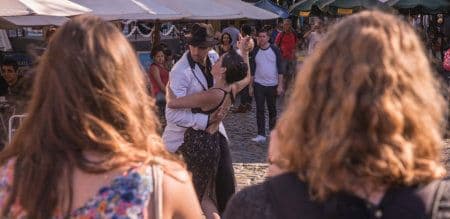
The neighbourhood is stunning to the eye, featuring narrow cobblestone roads, colonial buildings, cafes and tango parlors, historical churches, and a few beautiful city statues.  The artistic vibe that fills the streets today, came from a few local artists who began to infiltrate the area in the 1950’s, setting up art galleries, art walks, and cultural spots throughout the neighbourhood which later drew in a wide range of local and immigrant artists. The immigrant population in this area soon led to the popularity of Tango and over the years, San Telmo became one of the most famed tango neighbourhoods in the city.

Tango Shows
Historical Restaurants
Music Bars
Antique Shops
Trendy Clothing Shops
Churches
Bars and Nightclubs
Famous restaurants and cafes

Every Sunday, San Telmo also features a street market that extends for more than 10 blocks and ends up in the very popular Plaza Dorrego where cafes, bars, and a centre market can be found. Be sure to sit around and watch the street performers along the way!

**If you venture into San Telmo at night, be sure to walk on highly lit streets and always in a group.  If it is late, try not to walk at all and take a taxi to your next destination.**

→ No CommentsTags: argentina · buenos aires · study spanish

9 de Julio, 1816, El Dia de la Independencia in Argentina

June 29th, 2009 · No Comments


This 9th of July the people of Argentina will celebrate one of the most important holidays in the country, a holiday that exclaims Argentina’s freedom and independence. This holiday is fittingly called, ‘9 de Julio’ or ‘Dia de la Independencia’ (Independence Day), and for Spanish students in Buenos Aires, it is best to be celebrated with other local Argentines to really experience Argentina’s freedom.

What happened on 9 de Julio?

On July 9th, 1816, the Congress of Tucuman officially declared the independence of Argentina, gathering its surrounding provinces and establishing Argentina as a country, and cutting all ties with Spain.  Before this declaration, Spain had a wide control on the regions and provinces which today are what make up Argentina and South America, and continued to attempt to keep or regain control over its colonies throughout the Americas.   In 1815, delegate deputies were summoned from the surrounding provinces in order to hold a congress in the city of Tucuman in order to establish Argentina as a country and stop the rule of Spain. In 1816, deputies from the surrounding regions came to Tucuman and on July 9th, 1816, after much debate, a vote was taken, a decision was made, and Argentina was born.

If you are interested in celebrating this national holiday, just take to the streets this Thursday July 9th and take part in the many celebrations that will be held in the downtown area of Buenos Aires, the Avenida 9 de Julio, and close to Plaza de Mayo.

** Downtown Buenos Aires sees thousands of people on this day of celebration, so just make sure you stay with your group, hold your camera close, and just keep the money you will need for that day/night. Better safe than sorry!**

→ No CommentsTags: argentina · buenos aires · events, nightlife, and activities

The Argentine Food Guide for Spanish students in Buenos Aires. Part 3

June 26th, 2009 · No Comments


For any Spanish students in Buenos Aires this winter, we encourage you to spend at least one night at home in order to cook a traditional Argentine meal.  We know it is easy to go out to the many trendy and delicious restaurants in the city but creating your own argentine meal and then bringing home the recipe will put a little bit of Argentina back in your home country.

A very traditional, easy, and delicious recipe from Argentina is the famous Milanesa.  A milanesa is a thin piece of meat (pressed), often oval in shape, coated in bread crumbs and then either fried or baked.  This traditional Argentine treat can be found in almost any Argentine restaurant, supermarket, or family home, and is easy to make, easy to prepare, and hits the spot whether you are hungry or not.

Milanesas

Ingredients
4 meat patties (any meat of your choice, thinly sliced or pressed)
3 eggs, beaten
Salt, garlic powder, lemon juice
Bread crumbs
Vegetable oil

Instructions

1.  Flatten your chosen meat by pounding with a meat mallet until thin.

2. Beat the eggs lightly with the salt and pressed garlic.

3. Take each piece of meat and coat it with the egg mixture and then press it into the breadcrumbs.

4. You can cook the milanesas in either a frying pan, filled with a little bit of oil, or in the oven on a baking sheet, also oiled.

5. Depending on your taste, add as little or as much oil when cooking the milanesas.

6. You can serve it with mustard or on its own, with eggs, or beside a salad. Just make sure to enjoy it with friends and family!

Interested in more Argentine recipes?

→ No CommentsTags: argentina · buenos aires · food, drinks, and recipes

This winter, discover a colorful circus in Buenos Aires!

June 25th, 2009 · No Comments


This winter, Buenos Aires is livening up its entertainment and culture scene, bringing artists, acrobats, musicians, clowns, and more to the city for everyone’s viewing pleasure.  The Ministry of Culture, City of Buenos Aires, Cultures France, and the French Embassy in Argentina are pleased to present the first ever Buenos Aires International Circus Festival.

This fabulous and full of life festival will offer unique performances and experiences to the people of Buenos Aires, showcasing artists from around the world including, France, Spain, Brazil, and Israel, all placing a special focus on contemporary circus. The city of Buenos Aires is especially enthusiastic about this event as it has never been featured before in the city, and considering the wide array and colourful Buenos Aires arts cultural, this funky circus event is sure to be a complete success.

The circus will be held at Combate de los Pozos between June 29 and July 5th and each day will have its own schedule and fixed performances.  Each day the venue will feature circus performances, music shows, clowns, and other various presentations between 16:30 and 19:30, for free.  The other times of they day will feature specific artists, galas, short shows, and lively presentations.  During the festivals dates tickets can be purchased at the door (Combate de los Pozos 1700, 2:00-21:00) or can be picked up at the following venues beforehand:
(Advanced Free Tickets: Casa de la Cultura (Avenida de Mayo 575: 11:00-17:00)
Regular Tickets:
Lee-Chi – Avenida Santa Fe 1670, local 42-43 (Monday – Friday 12-21:00)
Lee – Chi – Avenida Cabildo 2316, local B17 (Monday – Saturday 11-19:00)

Are you interested in Studying Spanish in Buenos Aires this winter?

→ No CommentsTags: buenos aires · events, nightlife, and activities

What are you doing this July 9th on Argentina’s Independence Day?

June 23rd, 2009 · No Comments

If you are studying in Buenos Aires and would like to witness one of Argentina’s biggest national celebrations, the Dia de la Independencia (Independence Day) would be it. All over the country, in every city, town, and village, residents come outside and spend the day celebrating their countries independence though music, dance, ceremony, and festivities.

What happened on July 9th?

On July 9th of 1816, the Congress of Tucuman officially declared Argentina’s independence from Spain (in fact it was not even considered a country yet), and therefore severing all political ties between Argentina and Spain. This date also serves as the final date of voting in which the Congress of Tucuman decided, after much debate, to break away from Imperial control and move independently towards absolute self-rule. These two very special events in the realization of Argentina’s independence is why this national holiday is so celebrated throughout the country and why it is also referred to as Argentina’s day of birth.

What will you do this July 9th?

July 9th is celebrated with a national holiday, ceremony, and depending on where you are situated, everything from outdoor festivities to music and dance. In Buenos Aires, there is a ceremony held every year where thousands gather to celebrate this holiday together, as well as personal traditions such as spending the day together, celebrating with friends, hanging flags of your apartment balconies, honking, etc. No matter how you celebrate this holiday, with friends or family, make sure to get out in the city, bring your Argentine flag, and celebrate with locals, in real Argentine style.

If you are interested in combing Spanish and Dia de la Independencia, click here!

→ No CommentsTags: argentina · buenos aires · events, nightlife, and activities

Neighbourhoods in Buenos Aires: Palermo

June 22nd, 2009 · No Comments

If you are traveling abroad to Argentina, whether to live or study Spanish in Buenos Aires, there are a myriad of fantastic, interesting, and very Argentine neighborhoods to check out. However, there are a few that seem to stand out from the rest, and this week we are featuring Palermo.

One of the most picturesque neighborhoods in Buenos Aires, Palermo sits between Belgrano, Almagro, Colegiales, and Villa Crespo, and is the largest neighborhood in the city. Due to its grand size, Palermo is divided in separate areas including Alto Palermo, Palermo Viejo, Palermo Soho, Palermo Hollywood, and Palermo Chico. Each area is unique, some featuring modern buildings and others with old cobblestone roads, some areas are filled with business’s and others with nothing but wide roads and grassy parks. Regardless, Palermo offers something to everyone.

One of the most popular parts to visit for foreigners are Palermo Soho and Palermo Hollywood, each featuring beautiful apartment buildings, endless restaurants, bars and shops, and each very foreign friendly.   In Palermo Soho, there is the very famous Plaza Serrano, a plaza surrounded by restaurants with a centre market (great on the weekends!) and the equally famous Plaza Armenia, also featuring a market but also a small park and four cubic blocks of shops and restaurants.  This entire area is a great place to wander around in, enjoy an afternoon coffee, or discover the vibrant Buenos Aires nightlife.

The other areas of Palermo are great to explore as well, especially by reading through a guide book that can explain to you the best places to visit. Another must see is the Palermo Parks (Palermo Bosque), giving you the relaxation spot, right in the middle of the city!

→ No CommentsTags: argentina · buenos aires · study spanish

Preparing to study Spanish in Buenos Aires – 10 Pre-Travel Must-Do’s! (Part2)

June 19th, 2009 · No Comments

If you are planning on coming to Buenos Aires to study Spanish, there are a few must-do’s that will make your travel and transition into the beautiful city of Buenos Aires more successful.

1.    Enjoy all those things from home that you love before you leave. You will most likely not be able to enjoy them while you are abroad, of course you will find substitutes, so indulge while you are still at home!
2.    Take an address book with all the phone numbers, addresses, and email address’s, that you may need or want. While abroad this always comes in handy, and of course, leave some room in that address book in order to add new address’s and email’s of new people that you meet along the way.
3.    Make photocopies of every important document you have. You never know when you may misplace something, or god forbid, lose something, and it is always very helpful to have photocopies. Also, try to keep your photocopies in separate places or exchange them with friends; you carry theirs and they carry yours.
4.    Check out the address of your embassy in the city you are traveling to. This is always recommended by home countries to their residents that are traveling abroad.  If anything happens while abroad or you need any assistance, your home embassy will be happy to help.
5.    Be prepared, organized, and ready to have a lot of fun and experience a lot of new things. Traveling abroad, for any reason, is one of the most life changing and memorable experiences on can have, guaranteed to be talked about for years to come!

Ready to Study Spanish in Buenos Aires?

→ No CommentsTags: argentina · buenos aires · study spanish

The Argentine Food Guide for Spanish students in Buenos Aires.

June 18th, 2009 · No Comments


For any Spanish students in Buenos Aires this winter, we encourage you to spend at least one night at home in order to cook a traditional Argentine meal.

One of the most eaten foods in Argentina, filled with a myriad of different ingredients, including beef, cheese, ham, chicken, and veggies, is the very famous Empanada. Empanadas can be bought all over the city, from cafes to supermarkets, however it is a fun and easy snack to make, plus, you then can add any ingredients you like. (Below, we have used beef as the main ingredient)


Beef Empanadas

Ingredients
Dough:
400g Flour
1 tsp Salt
175g Butter
1 - 3 tbsp Water

**Note: At ANY supermarket in Buenos Aires, the empanada pastry can be bought, pre-made and prepared, leaving you only with the duty of filling the empanada. You choice!

Filling:
450g Minced Beef (depending on how many you make – measure yourself)
2 Onions chopped
1 tbsp Tomato Paste
1 hard boiled Egg, chopped
Salt & Pepper (or any seasoning you like)
Instructions

**Note: Ignore 1,2, and 4 if buying pre-made empanada pastry.

1. Put the flour in a mixing bowl and mix in the butter using your fingers.
2. Add the water, slowly, and mix until a spoon until the mixture combines.  Use your hands to form the mix into a ball and then cover and chill for one hour.

3. Cook the beef and other ingredients and let cool slightly.

4. Preheat the oven to 200C. Roll the pastry out on a lightly floured surface into about 3mm/1/8th inch of thickness and then cut into 8 small circles.

5. Fill the circles with the filling, and fold over the edges into half moons, securing the edges by pressing with a fork.

6. Cook for about 20-30minutes, until golden brown.

→ No CommentsTags: buenos aires · food, drinks, and recipes · study spanish


Like what you read? Why not come to Argentina and live the full experience? Find out about our Spanish courses and come to study Spanish in Buenos Aires!